What this service covers
Short-term (48-hour) testing for real-estate transactions or initial screening, plus 90-day long-term testing for the most accurate picture of household exposure. Testing is performed by NRSB- or NRPP-credentialed Cincinnati technicians. PDF reports compatible with mortgage and inspection requirements.
Typical pricing
$150-$300
Pricing varies by job specifics. Free phone or on-site quotes; fixed pricing once the technician has assessed the job.
Short-term, long-term, and continuous radon testing in Cincinnati
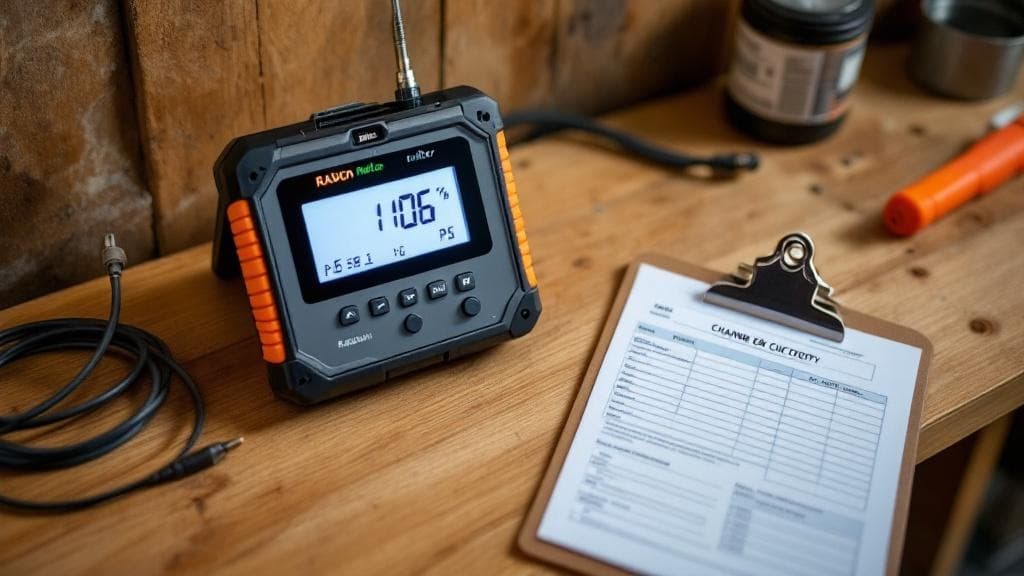
Three radon test types serve different decision contexts in Cincinnati. Short-term tests (48 hours to 7 days) use a continuous radon monitor (CRM) or a charcoal canister and produce a snapshot reading. Required for real-estate transactions because the closing window does not accommodate longer testing. Cost: $150-$300 for professional CRM testing with closed-house-conditions documentation, $15-$30 for a do-it-yourself charcoal canister mailed to a lab.
Long-term tests (90 days minimum, often 1 year) use alpha-track detectors that integrate radon decay over the deployment period and produce a true annual-average exposure figure. Cost: $30-$50. Most accurate option for households making a long-term mitigate-or-not decision; least accurate for real-estate timelines because the deployment window exceeds typical contingency periods.
Continuous radon monitors (CRMs) are the gold standard for real-estate transactions per ANSI/AARST MAH-2023 protocols, what FHA, VA, and conventional lenders prefer to see in inspection reports. The CRM logs hourly readings, providing a weather-context-aware result that defends against challenges that the test happened during an atypical low-radon week. Credentialed Cincinnati technicians deploy CRMs for every real-estate transaction and produce a closing-ready PDF report within 24 hours of monitor pickup.
EPA testing cadence and Cincinnati-specific triggers
EPA recommends testing every 2 years per the Citizen's Guide to Radon, plus immediate retest after any foundation work, HVAC change, basement renovation, or significant exterior excavation. The two-year cadence is conservative; many Cincinnati homeowners with documented post-mitigation readings under 2.0 pCi/L test annually because the cost is low and the upside is catching fan failure or seal degradation early.
Cincinnati-specific triggers that warrant testing regardless of cadence: any sump pit installation or replacement (sump pits are primary radon entry points), any rim-joist insulation retrofit (changes basement air-pressure dynamics), any spray foam install (tightens the home and shifts radon equilibrium), any addition that changes foundation footprint, or any waterproofing project. Hamilton County and parts of Hyde Park, Mariemont, and Madeira have aggressive freeze-thaw cycles that crack slabs on a 5-10 year timeline, opening fresh radon entry paths even when the original mitigation system is still working.
Real-estate transactions universally require fresh testing inside a 6-month window per FHA, VA, and most conventional lender contingency clauses. The buyer's inspector typically deploys the test; the seller arranges mitigation if levels exceed 4.0 pCi/L. Homes on septic systems also need a parallel real-estate septic inspection for the same lender package, and the timelines line up well in practice. Our Cincinnati timeline for real-estate-driven testing: same-day phone consultation, on-site assessment within 24 hours, monitor deployed at 4 PM, lender-ready PDF in your hand 48 hours later. Fits comfortably inside a 14-day inspection contingency.
What to do if your Cincinnati test lands between 2.0 and 4.0 pCi/L
About 30 percent of Hamilton County homes that test fall between 2.0 and 4.0 pCi/L, which is the EPA "consider mitigation" range. The action level is 4.0 pCi/L; below that the EPA does not require mitigation but explicitly recommends it for any home reading above 2.0 pCi/L when household-specific risk factors apply: children sleeping in lower-floor bedrooms, smokers in the household, basement workshop hours, or chronic respiratory conditions.
For borderline readings, our recommendation is a long-term test (90-day alpha track) before committing to mitigation. The short-term test could have caught a high-pressure week with elevated radon; the long-term test averages out that seasonality and produces a more accurate household-exposure number. If the long-term comes in below 2.0 pCi/L, monitoring is fine. If it comes in above 4.0, mitigate. If it lands again in the 2.0-4.0 range, the household-risk factors above tip the scale.
Cincinnati specific: heating-season testing (October to March) typically produces the highest readings because homes are sealed and stack effect is strongest. Summer testing produces lower readings. A short-term test in July that comes back at 3.2 pCi/L could easily be 5-6 pCi/L on a January retest. We recommend either testing during the heating season or placing more weight on a long-term result for borderline situations.
Cincinnati real-estate radon testing protocol and lender requirements
Real-estate radon testing follows tighter protocols than informational testing because the result drives transaction decisions. ANSI/AARST MAH-2023 specifies closed-house conditions: windows and external doors closed for 12 hours before the test and during the test period, HVAC running on normal mode, no occupant interference with the monitor. The credentialed technicians handling Cincinnati real-estate tests document closed-house conditions with seller signature and time-stamped photos, satisfying chain-of-custody requirements.
FHA, VA, and most conventional lenders accept ANSI/AARST conforming reports without requiring re-inspection. The report includes the deployment timestamp, retrieval timestamp, hourly reading log (CRM), final integrated reading in pCi per liter, the test technician's NRPP or NRSB credential page, and the closed-house conditions attestation. We deliver the report as PDF to the buyer's agent, seller's agent, and lender within 4 hours of monitor retrieval; closing-day attorney conferences sometimes ask for an additional copy on letterhead, which we re-issue same-day.
Cincinnati real-estate timeline that almost always works: day 0 buyer's inspector tests, day 2 result comes back, day 3 seller calls our dispatch, day 4 on-site assessment plus signed mitigation quote, day 5-6 install (4-8 hours), day 7-9 48-hour post-mitigation retest, day 9 lender-ready PDF delivered. Fits inside the standard 14-day inspection contingency with margin for weather. Dozens of Cincinnati transactions have closed on this timeline.
Service area
Radon Testing is available across Greater Cincinnati and Northern Kentucky. Per-suburb pages: